Blog
2026 Best Wine Filter Sheet Types for Global Buyers?
Choosing the right wine filter sheets in 2026 requires more than comparing prices or advertised micron ratings. Global buyers must evaluate filtration performance, material safety, supplier reliability, and regional compliance. A sheet that performs well in a small winery may behave differently in a high-volume bottling line. Real production conditions matter.
This guide examines common sheet types, including cellulose-based depth sheets, cellulose blends, and sheets designed for finer polishing or microbial reduction. Each type has a different balance of flow rate, retention capacity, clarity, and wine loss. Cellulose sheets may offer practical handling and broad availability. Finer grades can improve visual brightness, but they may clog faster. Some suppliers provide test data, traceability records, and food-contact declarations. Those documents deserve careful review.
The best choice depends on the wine, equipment, and filtration target. Red wines with higher solids may need stronger dirt-holding capacity. Delicate white wines may require gentle treatment and low flavor impact. Buyers should request samples and compare pressure increase, throughput, turbidity, and sensory results under realistic conditions. Small differences become expensive at scale.
No universal sheet is perfect. Supplier claims can also be incomplete. A reliable decision combines technical evidence, operator experience, and independent verification where possible. Buyers should also confirm packaging quality, storage conditions, lead times, and after-sales support. This article helps purchasing teams compare wine filter sheets with greater confidence, while recognizing that final validation still belongs in the winery.
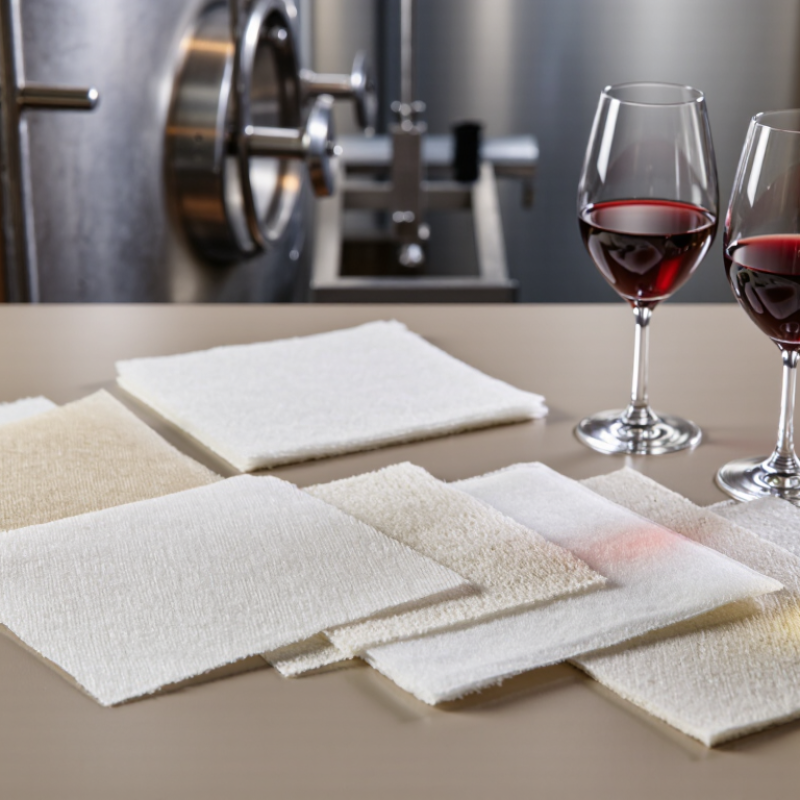
Wine Filter Sheet Types: Cellulose, Diatomaceous Earth, and Synthetic Fibers
2026 Best Wine Filter Sheet Types for Global Buyers
Wine filter sheet selection depends on wine style, clarity targets, equipment pressure, and production volume. Cellulose sheets offer balanced retention and gentle handling. They suit many still wines and can preserve delicate aromas when differential pressure remains controlled. Their fibers may swell during use, so operators should monitor flow rather than trust the rated capacity alone.
Diatomaceous earth sheets create a more open filtration structure. They can handle wines with moderate suspended solids and support stable throughput. However, mineral particles may affect pressure behavior if the wine is poorly settled. A trial run is essential.
Synthetic fiber sheets provide precise retention and stronger mechanical stability. They are useful for polishing stages, repeated processing, and automated systems. Some synthetic materials may reduce flow faster when the wine contains colloids.
Global buyers should request food-contact declarations, migration test results, pore-retention data, and batch traceability. Confirm the sheet dimensions, gasket compatibility, sterilization limits, and recommended storage humidity. A damp carton can damage performance before installation.
I once saw a sheet selected only by nominal micron rating; the wine still emerged hazy. The overlooked issue was upstream clarification.
Numbers help, but they do not replace process testing. Temperature, viscosity, and pump pressure can change results quickly. Small-scale trials with the actual wine remain the most reliable purchasing evidence.
Micron Ratings Explained: 1–5 µm Clarification and 0.45 µm Final Filtration
For global wine buyers, micron ratings should guide testing, not replace it. The OIV’s 2024 report estimated global wine production at about 225.8 million hectolitres, the lowest level since 1961. That scale increases pressure for repeatable clarification and stable filtration choices.
A 5 µm sheet can remove coarse particles, lees, and visible sediment. A 1–3 µm grade usually improves brightness and reduces fine suspended matter. However, tighter sheets may foul quickly when wine contains residual yeast, pectin, or colloids. Depth media also use nominal ratings, so results can vary between suppliers. I would request particle-count data and throughput results, not only a printed micron number.
The 0.45 µm stage is commonly selected for final microbial reduction before bottling. It is not automatically sterile. Membrane structure, pressure, integrity testing, and wine viscosity all affect performance. The OIV Compendium of International Methods of Wine Analysis emphasizes controlled analytical procedures, yet production lines still need product-specific validation. A practical trial can compare turbidity, flow rate, differential pressure, and sensory impact after 1, 3, and 5 µm clarification. Then test 0.45 µm filtration under real conditions. Small differences matter. A bright sample may still fail later. Temperature changes can expose that weakness.
Depth Sheets vs Membranes: Retention, Flow Rate, and Beta-Ratio Data
2026 Best Wine Filter Sheet Types for Global Buyers?
Depth sheets and membranes solve different filtration problems. Depth sheets trap particles through a graded fiber structure. They often handle variable solids better, especially after clarification or during early polishing. Membranes separate mainly at the surface. Their pore size is more defined, which can support tighter microbial control and repeatable retention.
Do not compare flow rates casually. Ask for test conditions, including wine temperature, viscosity, pressure drop, filter area, and turbidity. A depth sheet may deliver 80–250 L/m²/h under moderate differential pressure, but actual performance can change sharply with solids loading. Membrane flow may appear lower at first. Its decline can be easier to monitor through transmembrane pressure. Small details matter.
Beta-ratio data adds useful discipline. A beta ratio of 500 means approximately 99.8% particle removal at the stated particle size. It does not describe every particle size or guarantee stable performance in real wine. For example, beta 500 at 0.45 microns cannot replace complete validation across the intended process. I would request retention curves, not one attractive number. I would also test aroma, color, and dissolved gas after filtration. The clearest spreadsheet can still miss sensory changes. Temperature control remains essential. Keep records from pilot trials, including start and end flow rates. Truthfully, the “best” sheet is often the one matching the wine’s solids, target retention, and available operating pressure.
Selecting Sheets by Wine Stage: Lees Removal, Polishing, and Sterile Filtration
2026 Best Wine Filter Sheet Types for Global Buyers?
Filter sheets should match the wine stage, not merely the advertised micron rating.
For lees removal, choose coarse depth sheets with high dirt-holding capacity. They protect the polishing stage from rapid blockage.
Heavy lees can look like wet clay on the sheet surface. That visual check matters.
For polishing, medium-fine depth sheets usually remove haze-forming particles while preserving flow.
A cellar trial should record turbidity, pressure rise, and wine loss. The Australian Wine Research Institute notes that filtration performance depends on solids load, temperature, and pre-treatment.
Buyers often overlook temperature. Cold wine can move slowly and create misleading capacity results.
Sterile filtration requires tighter control.
A 0.45-micrometre membrane may support microbial reduction, while 0.2 micrometre filtration is often selected for higher microbial control.
Validation remains essential. A clean-looking sheet is not proof of sterility.
The International Organisation of Vine and Wine estimated 2024 global wine production at 225.8 million hectolitres, a historic low, increasing pressure to reduce product losses.
The OIV report supports efficiency, but efficiency should not replace verification.
Some suppliers publish impressive throughput figures without matching the buyer’s wine matrix.
Ask for test-fluid conditions, differential-pressure limits, extractables data, and integrity-test results.
The uncomfortable point is simple: the “best” sheet can fail when the cellar sequence is poorly designed.
Global Compliance Checklist: EU 1935/2004 and FDA 21 CFR Requirements
2026 Best Wine Filter Sheet Types for Global Buyers?
The OIV’s State of the World Vine and Wine Sector 2024 estimated global wine production at 225.8 million hectolitres, excluding juice and must. This scale increases demand for consistent filtration materials. Cellulose sheets remain common, while cellulose-mineral blends can improve flow and clarification. The material choice matters less than documented food-contact safety.
For EU sales, verify compliance with Regulation (EC) No 1935/2004, especially Article 3. Materials must not release substances that endanger health, alter wine composition, or damage taste. Regulation (EC) No 2023/2006 also requires good manufacturing practice. Request a Declaration of Compliance, migration test results, traceability records, and controlled production details. For the United States, check FDA 21 CFR 174.5 and the specific sections covering every sheet component. “FDA compliant” is too vague. Extraction conditions, wine acidity, temperature, and contact time must match the intended use. A supplier certificate alone may be incomplete.
Tips: Ask for the exact fiber, binder, mineral, and wet-strength chemistry. Match tests to the finished sheet, not only raw materials. Keep lot samples and incoming inspection records. Review packaging inks and adhesives too. These details are often missed. A small gap can stop a shipment. My own view is cautious: regulations define safety, but they do not guarantee filtration performance. Run pilot trials with your wine, because flow rate and sensory impact can change unexpectedly.
2026 Best Wine Filter Sheet Types for Global Buyers? - Global Compliance Checklist: EU 1935/2004 and FDA 21 CFR Requirements
Technical comparison of common sheet and membrane filter formats used for wine clarification, polishing, prefiltration, and final microbial reduction.
A. Wine Filter Sheet Type Comparison
| Filter sheet type | Typical composition | Primary wine application | Indicative retention range | Main advantages | Key limitations and buyer checks |
|---|---|---|---|---|---|
| Cellulose depth sheet | Purified cellulose fibers; may include approved wet-strength or process aids. | Coarse clarification, polishing, and removal of suspended solids. | Approximately 0.5–10 µm, depending on grade. | Good depth-loading capacity; suitable for many still-wine clarification stages; generally low extractables when properly manufactured. | May release fibers if poorly conditioned; verify wet strength, extractables, taste neutrality, and food-contact status of all additives. |
| Cellulose with diatomaceous earth | Cellulose fibers combined with porous diatomaceous earth, also called kieselguhr. | High-capacity clarification and polishing of wines with elevated turbidity. | Approximately 0.5–5 µm, depending on formulation and grade. | High dirt-holding capacity and effective depth filtration. | Mineral composition and particle-release testing are important; request heavy-metal, extractables, and food-contact documentation. |
| Cellulose with perlite | Cellulose fibers combined with expanded perlite mineral particles. | Clarification and prefiltration where high solids loading is expected. | Approximately 1–10 µm, depending on sheet grade. | Strong solids-holding performance and relatively high flow capacity. | Confirm mineral purity, particle-release limits, leachable substances, and suitability for acidic alcoholic beverages. |
| Polypropylene depth sheet | Thermally bonded or molded polypropylene fibers or porous polypropylene media. | Pre-filtration, coarse clarification, and protection of downstream membrane filters. | Approximately 0.5–20 µm, depending on construction. | Low fiber shedding when properly constructed; good chemical resistance and useful mechanical strength. | Confirm polymer identity, additives, oxidation stability, extractables, and compliance for the actual wine-contact temperature and time. |
| Polyethersulfone membrane sheet | Hydrophilic polyethersulfone microporous membrane, usually supported by a nonwoven backing. | Final polishing and microbial-reduction filtration before bottling, when validated for the product. | Common nominal or absolute grades include approximately 0.2–0.65 µm. | Naturally hydrophilic; good aqueous-wine throughput; available in fine-pore grades. | Membrane rating is not automatically a sterility claim; require bacterial-retention validation, integrity-test data, and compatibility testing with alcohol and sulfur dioxide. |
| Nylon membrane sheet | Hydrophilic polyamide membrane, commonly supported by a backing layer. | Fine polishing and microbial-reduction filtration for selected wine processes. | Common nominal or absolute grades include approximately 0.2–0.8 µm. | Good wetting and broad laboratory and process availability. | Polyamide can adsorb or interact with certain wine compounds; perform sensory, chemical-compatibility, and extractables testing before approval. |
| Activated-carbon composite sheet | Cellulose or synthetic support containing activated carbon particles. | Specialized reduction of color, odor, or selected organic compounds; not a routine microbial filter. | Particle retention commonly approximately 1–10 µm; adsorption performance is product-specific. | Can provide adsorption as well as particulate filtration. | May remove desirable aroma, color, or phenolic compounds; require sensory trials, adsorption data, and migration or particle-release testing. |
B. Global Compliance Checklist for Wine-Contact Filter Sheets
| Compliance area | EU buyer checklist | U.S. FDA buyer checklist | Documents or evidence to request |
|---|---|---|---|
| General food-contact framework | Demonstrate compliance with Regulation (EC) No 1935/2004, including no transfer of substances at levels that endanger health or adversely change food composition, taste, or odor. | Confirm that each material and additive is authorized for the intended food-contact use under applicable FDA requirements. | Signed food-contact declaration, material specification, composition statement, intended-use conditions, and change-control commitment. |
| Good manufacturing practice | Manufacturing should follow Commission Regulation (EC) No 2023/2006 on good manufacturing practice for materials and articles intended to contact food. | Verify controlled manufacturing, traceability, sanitation, and quality systems appropriate for food-contact articles. | GMP statement, quality certificate, lot traceability procedure, nonconformance procedure, and audit support. |
| Paper and cellulose components | Check applicable national or European measures for paper, board, fibers, additives, and mineral components where no single fully harmonized EU measure covers the complete filter. | Review applicable provisions in 21 CFR Parts 176.170 and 176.180 where relevant to paper and paperboard components and the food-contact conditions. | Fiber and additive list, extractives data, wet-strength chemistry, mineral purity data, and supplier regulatory assessment. |
| Plastic membrane or support layers | For plastic components, assess applicability of Regulation (EU) No 10/2011, including overall and specific migration requirements, as amended. | Check the specific polymer and additive provisions in 21 CFR Part 177 or other applicable FDA authorization routes. | Polymer identification, additive disclosure or regulatory basis, migration or extractables report, and conditions-of-use assessment. |
| Wine-specific conditions | Assess acidic food, alcoholic content, contact time, temperature, repeated or single use, and storage conditions according to the actual process. | Confirm that the intended alcohol level, acidity, temperature, and contact duration fall within the authorization or testing basis. | Written intended-use matrix, simulated-food selection, time-temperature conditions, and worst-case migration or extractables results. |
| Mineral filter aids | Verify the regulatory status and purity of diatomaceous earth, perlite, silica, pigments, and other inorganic components used in the sheet. | Confirm the applicable FDA basis for each mineral component and assess impurities, including heavy metals and crystalline silica where relevant. | Mineral specification, certificate of analysis, heavy-metal results, particle-release data, and applicable regulatory citation. |
| Performance and safety validation | Confirm that filtration performance does not create unacceptable changes in wine composition, aroma, taste, or odor. | Use documented validation appropriate to the intended process; a pore-size claim alone does not establish microbial safety or food-contact compliance. | Flow-rate and pressure data, retention test, integrity-test method, microbial challenge data where applicable, sensory evaluation, and particle-shedding results. |
| Traceability and packaging | Maintain traceability from raw materials to finished sheets and ensure packaging does not contaminate the filter. | Confirm lot identification, supplier controls, complaint handling, and packaging suitability for food-contact products. | Lot number, certificate of analysis, production date, shelf life, storage conditions, packaging specification, and recall procedure. |
C. Practical Selection Guide for Global Buyers
| Purchasing objective | Preferred starting format | Recommended validation focus |
|---|---|---|
| High solids loading and economical clarification | Cellulose depth sheet with diatomaceous earth or perlite. | Dirt-holding capacity, flow decline, mineral purity, particle release, and sensory neutrality. |
| General polishing before bottling | Fine cellulose depth sheet or polypropylene prefilter followed by a validated membrane stage. | Turbidity reduction, filter-life improvement, extractables, and compatibility with downstream equipment. |
| Fine microbial-reduction filtration | Hydrophilic PES or nylon membrane sheet in a validated fine-pore grade. | Bacterial-retention validation, integrity testing, wine compatibility, pressure limits, and aseptic handling. |
| Color or odor reduction | Activated-carbon composite sheet only when specifically justified. | Sensory impact, adsorption selectivity, release of carbon particles, and confirmation that desirable wine compounds are retained. |