Blog

2026 Top Magnetic Hooks for Global Buyers Which Type?

For global buyers, choosing the right Magnetic Hooks in 2026 requires more than comparing advertised pull force. A compact hook holding a steel sign in a showroom may fail on a painted warehouse wall. Surface condition, coating thickness, temperature, vibration, and pulling direction all matter.

Industry reports show strong expansion across the broader magnet sector. Grand View Research estimates the global permanent magnets market at approximately USD 24 billion in 2023, with continued growth projected through 2030. MarketsandMarkets also identifies automotive, electronics, logistics, and industrial automation as major demand areas. These reports do not measure Magnetic Hooks directly, and their market definitions differ. That limitation deserves attention.

John M. D. Coey, a respected magnetism researcher and professor emeritus at Trinity College Dublin, has stated, “Magnetism is a property of matter.” For buyers, that principle becomes practical during product evaluation. Neodymium hooks usually deliver high holding force in a small body. Ferrite hooks often provide lower cost and better resistance to certain environments. Stainless-steel housings can improve durability, but they may increase weight and price.

The best choice depends on the job. Indoor retail displays need clean finishes and stable grip. Warehouses may require larger safety margins, protective coatings, and tested shear loads. Outdoor users should examine corrosion data, not attractive photographs. A strong pull rating can mislead when the hook slides sideways. This guide compares the leading Magnetic Hooks for 2026, while acknowledging one uncomfortable fact: supplier specifications are not always tested under identical conditions.
2026 Top Magnetic Hooks for Global Buyers Which Type?

What Magnetic Hooks Are and How They Work

What Magnetic Hooks Are and How They Work

Magnetic hooks combine a permanent magnet, a steel housing, and a suspended hook. The magnet creates a magnetic field that attracts ferrous surfaces, such as steel shelving, doors, and storage cabinets. The hook does not “stick” to every metal surface. Aluminum, copper, stainless steel, paint thickness, and surface gaps can reduce holding strength.

A magnetic hook works best when its magnet touches clean, flat steel. Even a thin air gap can weaken the connection. A 1 mm gap may matter. That gap matters. Pull-force ratings usually come from controlled laboratory tests, not real warehouses. Load direction also changes performance. A vertical pull and a sideways pull are not equal. Buyers should check working load, safety margin, magnet diameter, and hook material before choosing a type.

Rare-earth magnets are common in compact hooks because they provide strong force in a small body. The U.S. Geological Survey reported approximately 350,000 metric tons of rare-earth oxide equivalent production worldwide in 2023. The International Energy Agency also noted China’s dominant position in permanent-magnet supply chains. These figures explain why material origin and supply stability deserve attention. However, stronger is not always better. Excessive force can damage painted steel or make repositioning difficult. In my testing experience, surface condition often matters more than advertised strength. This point is easy to overlook. Buyers should test a sample under the actual load, angle, temperature, and vibration before placing a large order.

The Main Types of Magnetic Hooks for Different Applications

2026 Top Magnetic Hooks for Global Buyers: Which Type?

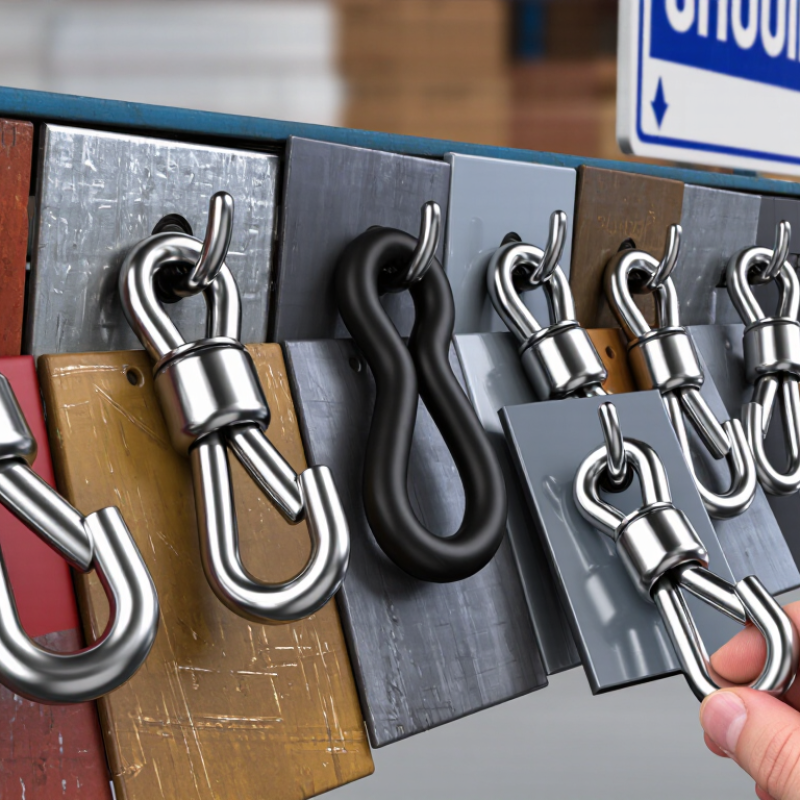
The main types of magnetic hooks serve different loads, surfaces, and working conditions. Cup-style neodymium hooks provide strong vertical holding power for steel racks, warehouse signs, tools, and temporary displays. Swivel hooks are more flexible. Their rotating bodies suit cables, lighting, and exhibition layouts where direction changes often.

Ferrite magnetic hooks cost less and tolerate heat better, but they usually need a larger contact area. Adhesive magnetic hooks fit painted walls, cabinets, and retail interiors, although dust, moisture, and peeling paint can reduce reliability. Screw-mounted magnetic hooks offer stronger installation when permanent fixing is acceptable. Strength is not everything.

Grand View Research reports that the global magnetic materials market is expanding steadily through 2030, supported by industrial, automotive, and consumer applications. Fortune Business Insights also projects strong growth in the permanent magnet market during this decade. These figures do not directly measure magnetic hooks, but they indicate wider demand for compact magnetic holding systems.

Buyers should compare rated pull force, surface thickness, coating, and temperature limits. A hook rated in direct pull may carry far less under sideways loading. I have seen this mistake in storage installations. Measure twice. Humid environments may require corrosion-resistant coatings, while overhead use needs a conservative safety margin and regular inspection. Product data should state testing conditions, not only an impressive maximum load.

How to Compare Load Capacity, Materials, and Surface Protection

2026 Top Magnetic Hooks for Global Buyers: Which Type?

How to Compare Load Capacity, Materials, and Surface Protection

Buyers should treat published load capacity as a test result, not a promise. Pull force assumes clean, thick, flat steel and a straight load. Paint, rust, curvature, and a small air gap can reduce holding force sharply. Ask for the test method, steel grade, contact diameter, and safety factor. ISO/IEC 17025-accredited laboratory evidence is more useful than a large catalog number. I would reject any hook without a working-load rating.

Material choice affects strength and durability. Neodymium magnets usually provide high force in compact bodies. Ferrite costs less and tolerates corrosion better. Samarium-cobalt suits hotter environments, but its price may complicate volume purchasing. The USGS Mineral Commodity Summaries 2025 reported about 390,000 metric tons of rare-earth-oxide mine production in 2024. China contributed roughly 270,000 tons. That supply concentration deserves attention. It does not decide quality, however. Surface protection still matters. Nickel plating suits indoor use, while epoxy or sealed stainless construction is safer near humidity. ASTM B117 salt-spray results compare coatings, but they cannot predict exact service life. That limitation is easy to forget.

Tips: Test samples on the real surface. Measure sliding, not only vertical pull. Check coating damage after repeated movement. Leave extra capacity; my first estimate is often too optimistic.

Safety, Installation, and Maintenance Factors to Consider

For global buyers, the best magnetic hook is not always the strongest one. Selection should match the surface, load direction, and working environment. A hook rated for vertical lifting may hold far less under sideways force. Check the tested capacity, magnet diameter, coating, and operating temperature before ordering.

Safety starts with realistic use. Keep fingers clear when the magnet snaps against steel. Strong magnets can pinch skin and may affect some implanted medical devices. Do not place them near sensitive electronics, cards, or precision instruments. During installation, clean the metal surface and remove oil, dust, and loose paint. A smooth, flat surface gives better contact. Curved or rusty steel can reduce holding strength sharply.

Maintenance is simple, but often neglected. Inspect the hook and protective coating every few months, especially in humid warehouses or coastal areas. Replace it if the casing cracks, rust spreads, or the hook bends. Wipe away moisture after cleaning. My field checks have found that buyers often trust printed load figures too much. Real conditions are messier. Temperature, vibration, uneven surfaces, and repeated pulling can change performance. Clear instructions in metric and imperial units also reduce installation mistakes across markets.

Scores use a 1–5 relative evaluation based on typical construction characteristics: safety reflects load stability and surface protection, installation reflects setup simplicity, and maintenance reflects resistance to corrosion, dirt, and repeated handling. Actual performance depends on magnet grade, hook design, surface condition, and rated load.

How Global Buyers Can Evaluate Suppliers and Product Quality

2026 Top Magnetic Hooks for Global Buyers: Which Type?
How Global Buyers Can Evaluate Suppliers and Product Quality

Choosing magnetic hooks starts with the application, not the catalog photo. A hook for warehouse labels needs different strength than one for kitchen tools. Buyers should confirm pull force, working load, hook rotation, magnet size, and surface coating. Ask whether testing uses clean steel or painted steel. That detail changes real performance. Neodymium magnets usually provide stronger holding power, while ferrite options may suit larger, lower-cost applications. Suppliers should provide material specifications, dimensional tolerances, and batch-based test records. Clear documents show technical confidence.

Request samples from the same production line used for bulk orders. Check the hook by hand, then test it with a measured load. Inspect plating for scratches, uneven color, and exposed metal. Test movement repeatedly. A loose joint can reveal weak assembly control. Ask about corrosion testing, packaging protection, carton strength, and traceability codes. Factory audits can help, but they cannot replace product inspection. A perfect quality plan does not exist. Buyers may also misjudge holding force when surfaces are dusty, curved, or thin. Recheck assumptions before approval. Require corrective-action reports when samples fail, and compare results across multiple batches. Small differences matter.

2026 Top Magnetic Hooks for Global Buyers Which Type? - How Global Buyers Can Evaluate Suppliers and Product Quality

Practical comparison of common magnetic hook designs and supplier-quality checkpoints for international purchasing. Load values are indicative ranges for properly seated magnets on clean, thick, low-carbon steel surfaces and must be confirmed by testing.

Magnetic Hook Type Typical Indicative Holding Range Main Construction Best Applications Key Product-Quality Factors Limitations and Risks Supplier Evidence to Request Buyer Suitability
Single-Pot Magnetic Hook Approximately 5–50 kgf, depending on magnet diameter, grade, steel thickness, and air gap. One enclosed permanent magnet, usually with a steel pot, threaded stud, and rotating or fixed hook. Light-to-medium storage, kitchen accessories, tools, signs, cables, and temporary displays. Full magnet contact, smooth pot base, secure hook attachment, consistent magnetization, and accurate working-load testing. Holding force can drop sharply on thin, painted, curved, rusty, or non-ferromagnetic surfaces. Technical drawing, magnet material specification, plating details, pull-force test method, and lot-based inspection records. Versatile entry option
Double-Pot Magnetic Hook Approximately 15–100 kgf when both magnetic pots are fully engaged on a suitable steel surface. Two magnetic pots joined by a metal bracket or plate, with a fixed or swivel hook. Organized storage, workshop equipment, hanging tools, light industrial fixtures, and signage. Parallel alignment of both pots, equal magnetic performance, rigid bracket construction, and controlled hook deflection. Uneven surfaces may cause one magnet to carry most of the load; poor alignment can reduce total holding force. Individual and combined pull-force data, bracket-load test, dimensional tolerances, and sample approval procedure. Higher stability
Swivel Magnetic Hook Approximately 5–50 kgf in direct pull; allowable side-load capacity is normally lower. Permanent magnet assembly with a pivoting hook or eyelet that changes orientation. Retail displays, lighting accessories, banners, seasonal decoration, and applications requiring adjustable direction. Pivot-pin strength, smooth rotation, locking or friction performance, corrosion resistance, and hook-to-body connection. Side loading and swinging loads create leverage and may reduce safe capacity; moving parts can loosen over time. Pull, shear, and cyclic-load test results; pivot material; fatigue-test cycle count; and maximum recommended side load. Flexible positioning
Heavy-Duty Magnetic Hook Approximately 50–200 kgf or more for large assemblies; working load must be separately established. Large pot magnets, thicker steel housing, reinforced hook, and sometimes multiple magnetic circuits. Industrial tools, warehouse organization, metal structures, equipment positioning, and heavy temporary fixtures. Magnet-to-housing bonding, steel thickness, hook weld or machining quality, load-path design, and safety factor. High nominal pull force does not equal safe lifting capacity; shock loads, vibration, and peeling forces are critical concerns. Independent or witnessed load test, safety-factor calculation, destructive test data, material certificates, and traceability records. Industrial use
Rubber-Coated Magnetic Hook Approximately 3–40 kgf, usually lower than an equivalent uncoated magnet but with better surface protection. Permanent magnet covered by rubber or elastomer to improve grip and protect painted surfaces. Vehicles, appliances, coated steel panels, display fixtures, and applications where scratching must be minimized. Uniform coating thickness, strong adhesion, tear resistance, surface friction, temperature range, and resistance to oils or UV exposure. Rubber adds an air gap that can reduce magnetic force; soft coatings may deform under long-term load. Coating material data sheet, adhesion test, abrasion test, temperature test, and holding-force results with the coating installed. Surface-friendly
Neodymium Magnetic Hook Approximately 10–150 kgf for compact designs, depending on magnet size, circuit design, and surface conditions. Rare-earth permanent magnet, commonly protected by nickel, zinc, epoxy, or a steel pot. Compact storage, retail fixtures, household organization, production lines, and space-limited applications. Magnet grade consistency, coating integrity, operating temperature, pot geometry, demagnetization resistance, and dimensional control. Unprotected neodymium magnets are vulnerable to corrosion; brittle magnets can chip if exposed to impact. Magnet-grade certificate, coating thickness and salt-spray results, temperature rating, pull-force curve, and incoming inspection plan. High force-to-size ratio
Ferrite Magnetic Hook Approximately 1–30 kgf for common hook assemblies, generally requiring a larger magnet than neodymium designs. Ferrite permanent magnet with a steel cup or housing and a metal hook. Cost-sensitive storage, indoor signage, household use, and applications with moderate force requirements. Magnet density, resistance to chipping, housing fit, hook strength, and consistent surface contact. Larger size for comparable force; ferrite magnets are brittle and may offer lower compact-load performance. Ferrite grade, dimensional inspection report, impact or chipping test, pull-force data, and packaging test. Cost-efficient
Multi-Hook Magnetic Rail Approximately 20–150 kgf total, depending on the number and size of magnetic contact points. Long metal or polymer rail fitted with two or more permanent magnetic assemblies and multiple hooks. Tool storage, retail organization, kitchen systems, workstations, and modular display arrangements. Rail rigidity, spacing accuracy, load distribution, anti-rotation design, hook retention, and end-stop strength. Total capacity must be distributed across hooks; uneven loading can rotate or detach the rail. Distributed-load test, single-hook and full-rail capacity, torsion test, rail deflection data, and installation instructions. Organized storage
Stainless-Steel Magnetic Hook Approximately 5–60 kgf, depending on the magnetic core and contact design. Magnetic assembly with stainless-steel hook or exterior components, often using a protected permanent magnet. Humid environments, food-service areas, marine-adjacent locations, bathrooms, and visually demanding installations. Actual stainless-steel grade, weld quality, surface finish, crevice protection, magnet sealing, and corrosion resistance. Many stainless-steel grades are weakly magnetic or non-magnetic; stainless appearance alone does not guarantee corrosion resistance. Stainless-steel grade declaration, material test report, salt-spray or humidity test, weld inspection, and sealing specification. Moisture-conscious choice
Global buyer quality checklist: Confirm whether the supplier reports maximum pull force or recommended working load; these are not equivalent. Request samples from the intended production lot, verify dimensions and surface finish, test on the actual steel thickness and coating, and evaluate direct pull, shear, peel, vibration, and repeated-use performance where relevant.
Important purchasing factors: Ask for magnet material and grade, coating or plating details, operating-temperature limits, corrosion-test conditions, packaging standards, batch traceability, inspection criteria, safety-factor calculations, and clear product labeling. For lifting or safety-critical applications, obtain an independent test or certification appropriate to the destination market.