
Blog
What Are the Top Heavy Duty Tools for Professionals?
Choosing the right Heavy Duty Tools is not merely a buying decision. It affects productivity, safety, repair quality, and long-term operating costs. Professionals need equipment that performs under dust, vibration, torque, heat, and repeated daily use. Performance matters.
Market evidence supports this demand. Grand View Research reports continued expansion in the global power tools market, driven by construction, manufacturing, automotive repair, and infrastructure investment. Global Market Insights also identifies cordless technology, brushless motors, and battery platforms as major growth drivers. These trends explain why modern professionals increasingly compare torque output, runtime, ergonomics, and service support—not only purchase price.
Safety remains equally important. The U.S. Bureau of Labor Statistics recorded 5,283 fatal work injuries in 2023, although tools represent only one part of that wider risk picture. OSHA recommends regular inspections, correct guarding, suitable personal protective equipment, and proper training before tool operation. Standards such as ANSI B107 for hand tools and IEC 62841 for many motor-operated tools provide useful benchmarks for design and testing.
This guide evaluates top Heavy Duty Tools through a practical professional lens. It considers impact wrenches, rotary hammers, grinders, saws, hydraulic equipment, and specialized hand tools. Real jobsite details matter: a drill must survive a dropped battery, an impact wrench must maintain fastening consistency, and a grinder must manage heat during long cuts. No ranking is perfect. Brand availability, service networks, and user technique can change the result. Still, careful comparisons can reveal which tools deserve a place in a demanding toolbox.
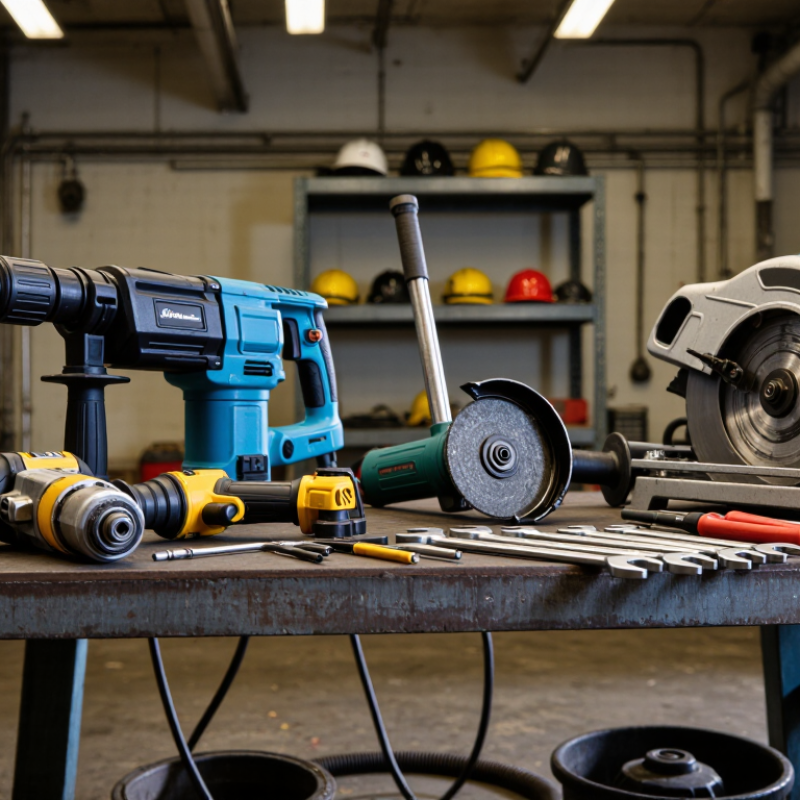
Set the Benchmark: Torque, Power, Load Capacity, Runtime, and IP Rating
Choosing heavy-duty tools means judging how they perform under sustained work, not just how impressive a specification looks. Torque matters for driving large fasteners or loosening stubborn fittings, but high torque alone does not guarantee control. Check whether the tool offers adjustable settings, a side handle, and a clear way to manage kickback. That detail matters.
Power should match the material and task. A tool cutting dense timber faces different demands from one drilling metal. Look for steady performance under load, not only a peak power figure. Load capacity deserves the same scrutiny: confirm the rated limit for the tool and its attachments, then leave a sensible margin. A rating is a boundary, not a target.
Runtime depends on workload, battery capacity, temperature, and maintenance, so advertised hours may not reflect a full shift. Consider spare batteries or charging access where downtime is costly. IP ratings also need careful reading. They indicate tested resistance to dust or water, not universal protection in every site condition. One buying-guide weakness is treating these numbers as guarantees. Compare the rating with the actual environment, and inspect seals and housings regularly. A minute spent checking the manual can prevent an expensive mismatch.
What Are the Top Heavy Duty Tools for Professionals? — Set the Benchmark: Torque, Power, Load Capacity, Runtime, and IP Rating
| Professional Tool Class | Torque | Power Platform | Typical Fastener Capacity | Estimated Runtime | Typical IP Rating |
|---|---|---|---|---|---|
| Compact 1/2-inch cordless impact wrench | 200–450 Nm fastening torque | 18–20 V battery platform; roughly 400–800 W peak electrical input | Commonly suited to fasteners up to about M16, depending on grade and joint | Approximately 150–400 medium-duty fastenings per 5 Ah battery | Varies by model; some are IPX4-rated, while others have no published IP rating |
| General-duty 1/2-inch cordless impact wrench | 500–1,000 Nm fastening torque | 18–20 V battery platform; roughly 700–1,200 W peak electrical input | Commonly suited to fasteners up to about M20 | Approximately 100–300 medium-duty fastenings per 5 Ah battery | Varies by model; check the product’s declared IP code |
| High-torque 1/2-inch cordless impact wrench | 900–1,500 Nm fastening torque; loosening torque may be higher | 18–20 V battery platform; roughly 900–1,500 W peak electrical input | Commonly suited to fasteners around M20–M24, subject to application | Approximately 50–180 heavy-duty fastenings per 5 Ah battery | Varies by model; an IP rating should not be assumed |
| 3/4-inch cordless impact wrench | 1,000–2,000 Nm fastening torque | 18–20 V battery platform; roughly 1,000–1,800 W peak electrical input | Commonly suited to fasteners around M24–M30 | Approximately 40–150 heavy-duty fastenings per 5 Ah battery | Varies by model; verify the rating before use in wet or dusty environments |
| 1-inch cordless impact wrench | 1,500–3,000 Nm fastening torque | 18–20 V high-output battery platform; roughly 1,200–2,000 W peak electrical input | Commonly suited to fasteners around M30–M36 and larger, depending on the tool | Approximately 20–100 heavy-duty fastenings per 5 Ah battery | Varies by model; use only the protection level stated by the manufacturer |
Benchmark note: Figures are indicative class-level ranges, not specifications for a particular tool. Actual torque, electrical input, fastener capacity, runtime, and IP protection vary by model, battery, fastener grade, joint condition, and work technique. Impact wrenches are not precision torque-control tools; use a calibrated torque wrench when a specified final tightening torque is required. IPX4 indicates protection against water splashes, not immersion.
Related Posts
-
Empowering Global Buyers with Top Quality Professional Tools from Leading Export Factories
-

7 Best Specialty Tools to Elevate Your DIY Projects
-

5 Tips for Choosing the Right Heavy Duty Tools for Every Job
-
Unlocking Precision with Specialty Tools for Every DIY Enthusiast
-

7 Essential Home Tools That Every Global Buyer Should Consider
-

Enhancing Household Tools Longevity Through Exceptional Support and Future Innovations